

AEO and GEO: The Future of Search Optimization
Aug 26, 2026
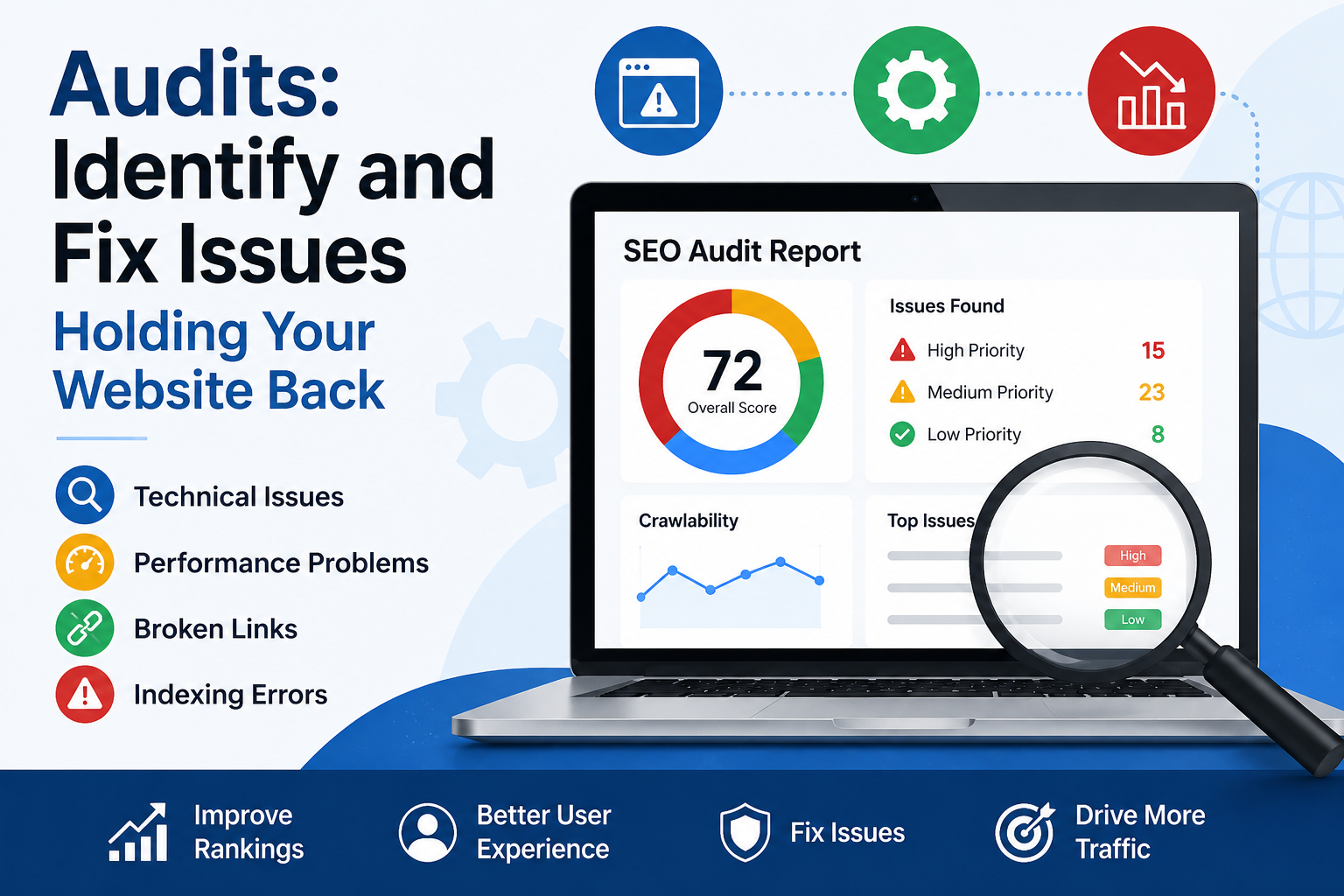
If your website is not attracting enough organic traffic, generating qualified leads, or appearing prominently in search results, the problem may not be your product or service. Technical errors, weak content, poor site architecture, indexing problems, and an ineffective internal linking structure can all limit your search visibility.
An SEO audit gives you a practical way to uncover these issues. Instead of guessing why your website is underperforming, you can examine its technical health, content quality, user experience, local visibility, and authority signals.
Whether you manage a local business, e-commerce store, service website, or growing company, a well-planned SEO audit helps you understand what is working, what needs improvement, and which actions deserve priority.
An SEO audit is a systematic evaluation of your website’s ability to be crawled, indexed, understood, and ranked by search engines.
During an audit, you review important areas such as:
The goal is not simply to produce a long list of errors. You should use the audit to identify issues that can affect visibility, traffic, conversions, and overall website performance.
For example, fixing a critical indexing problem may be more valuable than changing dozens of minor meta descriptions. Prioritization helps you focus your resources where they can make the greatest difference.
Search engines continuously evaluate websites using numerous technical, content, relevance, usability, and authority signals. Your website can gradually develop problems as you publish new pages, change templates, add plugins, migrate platforms, or update content.
An SEO audit helps you catch these problems before they become larger obstacles.
You can use an audit to:
Regular auditing also gives you a benchmark. Once you implement improvements, you can compare future performance against your original findings.
Technical SEO creates the foundation for your entire website. If search engines struggle to crawl or understand your pages, even excellent content may fail to reach its potential.
Begin by checking your robots.txt file. Make sure you are not accidentally blocking important pages, directories, scripts, or resources that search engines need to access.
Next, review your XML sitemap. It should contain the important URLs you want search engines to discover and index. Remove outdated, redirected, duplicate, or irrelevant URLs where appropriate.
You should also examine:
Use Google Search Console and reliable crawling tools to identify technical problems. Do not automatically treat every warning as equally important. Evaluate each issue based on its effect on users, crawling, indexing, and organic visibility.
A slow website can create friction for visitors and make it harder for users to interact with your pages.
Review your Core Web Vitals and overall page performance. Pay particular attention to loading speed, visual stability, and interaction responsiveness.
You can improve performance by:
Do not focus solely on achieving a perfect technical score. Your objective should be to create a fast, stable, and useful experience for real visitors.
Your website structure should make sense to both users and search engines.
Organize related pages into logical categories and create a clear hierarchy. Important service, product, and location pages should not be buried several clicks away from your homepage.
A strong structure can help you:
Use descriptive navigation labels and avoid unnecessary complexity. If you have dozens of pages covering similar subjects, consider whether they should be consolidated, reorganized, or supported with stronger internal links.
Your pages should clearly communicate their purpose.
Review title tags, meta descriptions, headings, URLs, image alt text, and body content. Each important page should target a clear search intent rather than attempting to rank for every related keyword.
Avoid keyword stuffing. Instead, use natural variations, related concepts, entities, questions, and terminology that genuinely help explain the subject.
For example, a page targeting a local service should naturally explain the service, its benefits, service area, process, common concerns, and relevant customer questions.
You can also strengthen pages by adding:
A technical audit alone will not reveal every reason your website struggles.
Review your content to determine whether each page satisfies the search intent behind its target query. A page may contain the right keywords but still perform poorly if it does not answer the user’s actual question.
Look for:
Instead of publishing content simply to increase page count, build useful resources that solve specific problems.
Content should demonstrate experience, expertise, authoritativeness, and trustworthiness. Include accurate information, transparent business details, credible references where appropriate, and practical advice.
Internal links help users move between related pages while helping search engines understand your site’s structure.
Use short, descriptive anchor text that tells readers what they will find after clicking. For example, instead of using generic phrases such as “click here,” use contextual phrases such as technical SEO services, local SEO strategies, or professional SEO guidance when they accurately describe the destination.
Your most important commercial pages should receive relevant internal links from supporting blog posts and related resources.
You can also create topic clusters by connecting:
This approach creates a more connected website and gives visitors clearer next steps.
If you serve a specific city, region, or service area, your audit should include local SEO.
Check your business name, address, phone number, business categories, location information, and local landing pages for consistency.
Your website should clearly communicate where you operate and what you offer. Avoid creating low-value location pages that simply replace a city name while leaving the rest of the content unchanged.
Instead, provide genuinely useful local information, including:
For GEO and AI search visibility, structure important information so it can be easily understood and extracted. Use clear questions and direct answers, descriptive headings, concise explanations, structured data where appropriate, and consistent business information.
Structured data can help search engines understand important entities and relationships on your website.
Depending on your business and content, relevant structured data may include organization, local business, product, service, article, breadcrumb, or other applicable types.
Do not add schema simply because it is available. Use only markup that accurately represents visible and relevant information on the page.
After implementation, validate your structured data and monitor it for errors or changes.
Backlinks can contribute to your website’s authority, but quantity should never be your only measurement.
Review the websites linking to you and consider whether those links are relevant, credible, and naturally earned.
Look for unusual patterns such as:
Your long-term strategy should focus on earning valuable mentions through useful content, digital PR, partnerships, industry resources, original research, and genuine relationships.
One of the biggest mistakes you can make is completing an SEO audit and then doing nothing with the results.
Create a prioritized action plan. Categorize findings as critical, high priority, medium priority, or low priority.
For example:
Critical: Indexing errors, major technical problems, broken conversions, or severe mobile usability issues.
High priority: Poor page speed, weak core service pages, significant content gaps, and problematic site architecture.
Medium priority: Internal linking improvements, metadata optimization, content updates, and image optimization.
Low priority: Minor wording changes or small technical warnings with limited impact.
Assign responsibility and deadlines to important tasks. Then measure changes in rankings, organic traffic, impressions, conversions, crawlability, and engagement.
You can handle many basic SEO checks yourself, but complex websites may require specialized expertise.
Consider working with a Pro Seos Agency when your website has hundreds or thousands of pages, multiple locations, technical migration issues, declining organic traffic, complicated international SEO requirements, or persistent ranking problems.
A professional audit can combine technical analysis, competitive research, content evaluation, keyword strategy, local SEO, and conversion considerations into one practical roadmap.
Before choosing an agency, ask how it conducts audits, how it prioritizes recommendations, what tools it uses, and how it measures results. Avoid providers that promise instant rankings or rely entirely on automated reports without explaining what the findings mean for your business.
An SEO audit should not be treated as a one-time activity.
Search behavior changes. Competitors publish new content. Search engines update their systems. Your website also changes as your business grows.
Create a recurring audit schedule based on your website size and activity. A small business website may benefit from periodic reviews, while larger websites with frequent publishing or technical changes may need more frequent monitoring.
Keep records of major SEO changes and compare performance over time. This makes it easier to identify which improvements are producing meaningful results.
Most importantly, always connect SEO work to business objectives. More traffic is useful, but qualified traffic, leads, sales, bookings, calls, and customer engagement are often more meaningful measures of success.
A comprehensive SEO audit gives you a clearer view of what is holding your website back. By examining technical health, website architecture, content quality, internal links, page performance, backlinks, local SEO, and search intent, you can replace guesswork with a structured improvement plan.
Start with the issues that can have the greatest impact, fix problems systematically, and monitor your results. When you combine technical accuracy with useful content and a strong user experience, your website becomes easier for search engines to understand and more valuable to the people you want to reach.
You should conduct a comprehensive SEO audit at least once or twice a year. Larger websites, frequently updated sites, and businesses experiencing traffic changes may benefit from more frequent technical and performance checks.
An SEO audit can identify technical errors, indexing problems, slow pages, weak content, broken links, duplicate content, poor internal linking, mobile usability issues, local SEO gaps, and backlink concerns.
An audit itself does not improve rankings. It identifies problems and opportunities. Implementing the recommended fixes can improve crawlability, relevance, usability, content quality, and overall search performance.
A comprehensive audit can include local SEO. You can review business information, location pages, local content, citations, Google Business Profile signals, reviews, and local search visibility as part of the process.
Prioritize issues according to their potential impact, urgency, implementation difficulty, and business value. Fix critical indexing and technical problems first, then address high-impact content, performance, internal linking, and conversion opportunities.