

AEO and GEO: The Future of Search Optimization
Aug 26, 2026
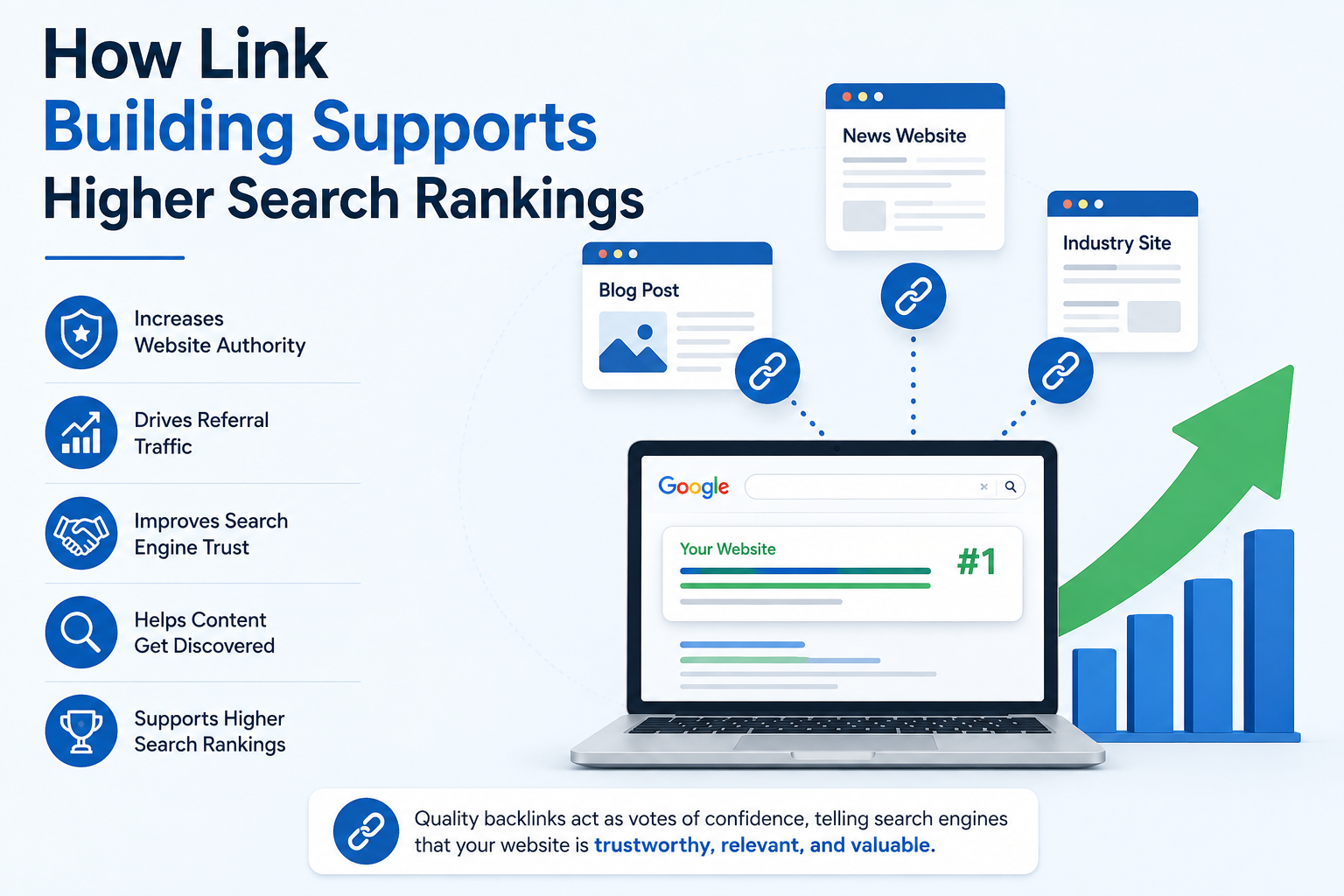
If you want your website to earn stronger search visibility, you need more than well-written content and optimized pages. Search engines also look at how other websites reference and recommend your site. This is where link building becomes an important part of your SEO strategy.
Link building involves earning relevant hyperlinks from other websites to your own. When reputable websites link to your pages, they can send valuable referral traffic while also helping search engines understand that your content is useful, credible, and relevant.
However, successful link building is not about collecting as many links as possible. You need to focus on quality, relevance, authority, and natural placement. A small number of trustworthy links from respected websites can be more valuable than hundreds of low-quality links.
In this guide, you will learn how link building supports higher search rankings, which strategies can help you earn valuable backlinks, and how you can build links without putting your website at unnecessary risk.
Link building is the process of acquiring backlinks from external websites that point to pages on your website. A backlink acts as a connection between two websites and can help users discover additional information.
For example, if an industry publication references your detailed SEO guide and links to it, that link can provide both referral visitors and a valuable signal of relevance and authority.
You can approach link building through several methods, including:
The objective should always be to earn links because your content deserves to be referenced.
Search engines evaluate many signals when determining which pages deserve visibility. Links from established and relevant websites can contribute to your website’s overall authority and credibility.
When respected sources repeatedly reference your content, it can reinforce your website’s position within its subject area. This is particularly useful when you consistently earn links related to your industry.
You should therefore prioritize backlinks from websites that are:
Avoid treating every backlink as equally valuable. Relevance and quality matter.
Links can also support website discovery. Search engine crawlers can follow links from one page to another, helping them find content that may otherwise be difficult to discover.
This becomes especially important when you publish new resources, service pages, research, or location-specific content.
You can make discovery easier by combining external backlinks with a strong internal linking structure. Internal links connect related pages on your own website, while backlinks connect your website with external sources.
Together, these connections create a clearer path for users and search engines.
A valuable backlink can do more than support SEO. It can introduce your business to an audience that already has an interest in your products, services, or expertise.
Imagine an industry website publishes an article about improving online visibility and references your SEO resource. Readers may click the link because they want additional information.
This traffic can be highly relevant because visitors arrive from a source connected to your subject.
For this reason, you should evaluate backlinks based on potential referral value, not only their SEO metrics.
Relevant backlinks can help reinforce what your website is about.
Suppose you operate an SEO business and consistently earn links from marketing publications, technology websites, business blogs, and digital marketing resources. These relationships create a stronger contextual connection around your expertise.
You should build links to pages that genuinely deserve attention rather than sending every backlink to your homepage.
Relevant service pages, research studies, guides, and educational resources can all become useful link targets.
One of the biggest mistakes you can make is assuming that more backlinks automatically mean better rankings.
A large backlink profile containing irrelevant, manipulative, or poor-quality links can create problems. Search engines are designed to identify unnatural linking practices, so you should avoid shortcuts designed solely to manipulate rankings.
Instead, concentrate on earning links that make sense for users.
Before pursuing a backlink opportunity, consider:
Is the website relevant?
A link from a website in your industry or a closely related field is generally more meaningful than a completely unrelated link.
Would its audience benefit from your content?
If the answer is yes, the link has genuine user value.
Does the website appear trustworthy?
Review its content quality, editorial standards, reputation, and overall website experience.
Is the link contextually appropriate?
A naturally placed link within useful content is preferable to a link inserted without meaningful context.
Your ability to earn backlinks often depends on what you publish.
If your website contains generic pages that offer little beyond information already available elsewhere, convincing other publishers to link to them can be difficult.
Instead, create resources that provide a clear reason for others to reference them.
Consider developing:
When you create genuinely useful content, outreach becomes easier because you are presenting something valuable rather than simply asking for a backlink.
Digital PR can combine public relations with SEO-focused content promotion. You can create newsworthy information and pitch it to journalists, editors, bloggers, and industry publications.
For example, you could publish original research about search behavior, website performance, local business visibility, or digital marketing trends.
The key is to provide a strong story.
Instead of sending generic emails such as “Please link to my website,” explain why your research, data, expert opinion, or resource is relevant to the publication’s audience.
This approach can generate both brand exposure and valuable editorial references.
Link building becomes more sustainable when you develop genuine professional relationships.
You can connect with:
Start by contributing value. Share useful insights, answer questions, participate in relevant discussions, and create resources that help others.
Over time, these relationships can create legitimate opportunities for collaboration, interviews, guest contributions, expert quotes, and editorial mentions.
If you are comparing providers or looking for professional SEO support, you can explore a Pro SEO Agency to understand how strategic SEO services can support your broader search visibility goals.
Link building is also useful for local SEO.
If you operate in a specific city or service area, links from locally relevant websites can help reinforce your geographic relevance. Local newspapers, business directories, chambers of commerce, community organizations, industry associations, and regional publications can provide valuable opportunities.
You can strengthen your local strategy by:
Do not create location pages or acquire links simply to insert city names. Your local content and link relationships should provide genuine value to people in the area.
Anchor text is the clickable text used within a hyperlink. It provides context about the destination page.
You should keep anchor text natural and descriptive. Avoid repeatedly using an exact-match keyword in every backlink because an unnatural pattern can look manipulative.
For example, instead of forcing the same commercial keyword repeatedly, you can use varied phrases such as:
The anchor should fit naturally within the sentence and accurately describe what users will find after clicking.
External backlinks can bring authority and visitors to your website, but internal links help distribute relevance throughout your own site.
When you publish a new article, look for existing pages that provide additional information. Link between closely related topics using descriptive anchor text.
For example, an article about backlinks could internally connect to pages covering technical SEO, content marketing, local SEO, keyword research, or SEO audits.
This creates a stronger information structure and helps visitors discover related resources.
Link building should not end after you acquire a backlink. You should regularly review your backlink profile to understand which websites are linking to you.
Monitor factors such as:
Regular monitoring can help you identify successful strategies and spot unusual patterns early.
You should also evaluate whether your link acquisition efforts are producing meaningful results. Ranking improvements, organic traffic, referral visits, conversions, and brand visibility are more useful indicators than simply counting backlinks.
You should avoid strategies that attempt to manipulate rankings through artificial links.
Be cautious about:
A sustainable SEO strategy focuses on earning recognition rather than manufacturing it.
You need measurable goals to determine whether your link-building efforts are working.
Track:
Give your strategy enough time to produce meaningful data. Search visibility rarely changes overnight, and a backlink may contribute indirectly through authority, discovery, referral traffic, and increased brand recognition.
The strongest approach is to make link building part of your overall SEO plan rather than treating it as a separate task.
Start by identifying pages that have strong potential to attract links. Improve their usefulness, conduct competitor and backlink research, identify relevant websites, create personalized outreach campaigns, and measure the results.
You should also refresh successful resources regularly. Updated statistics, new examples, improved visuals, and current industry insights can make existing content more attractive to publishers.
Most importantly, think about the person behind every link. If the backlink helps users discover accurate, useful information, you are much more likely to build a sustainable SEO asset.
Link building can support higher search rankings by strengthening authority, improving content discovery, generating referral traffic, and reinforcing topical and local relevance. However, the value of your strategy depends on the quality of the relationships and content behind the links.
You should focus on earning relevant editorial mentions, publishing genuinely useful resources, building industry relationships, and maintaining a natural backlink profile. When you combine these efforts with strong technical SEO, valuable content, internal linking, and local optimization, you create a more complete search strategy.
If you want to improve your website’s search visibility with a strategic approach, you can Contact Us to discuss your SEO requirements and identify opportunities for sustainable growth.
Link building can strengthen your website’s authority, help search engines discover content, increase referral traffic, and reinforce topical relevance. Quality backlinks from relevant and trustworthy websites are generally more valuable than large numbers of low-quality links.
There is no fixed number of backlinks required to rank. Your results depend on competition, content quality, website authority, search intent, and backlink relevance. Focus on earning valuable links rather than reaching an arbitrary backlink target.
No. Backlinks vary significantly in quality and relevance. A contextual link from a reputable, relevant website can provide more value than numerous links from unrelated or low-quality sources.
Yes. Links and mentions from relevant local websites, community organizations, regional publications, and industry associations can strengthen geographic relevance and support local search visibility when they are genuinely useful and relevant.
Link-building results can take time because rankings depend on multiple SEO factors. You may see gradual improvements in visibility, referral traffic, and authority as search engines discover and evaluate new links and your broader SEO efforts.