
How Link Building Supports Higher Search Rankings
Aug 25, 2026
Search is changing faster than traditional SEO strategies can keep up. People no longer rely only on short keywords and lists of blue links to find information. They ask complete questions, use voice assistants, interact with AI-powered search tools, and expect direct, useful answers.
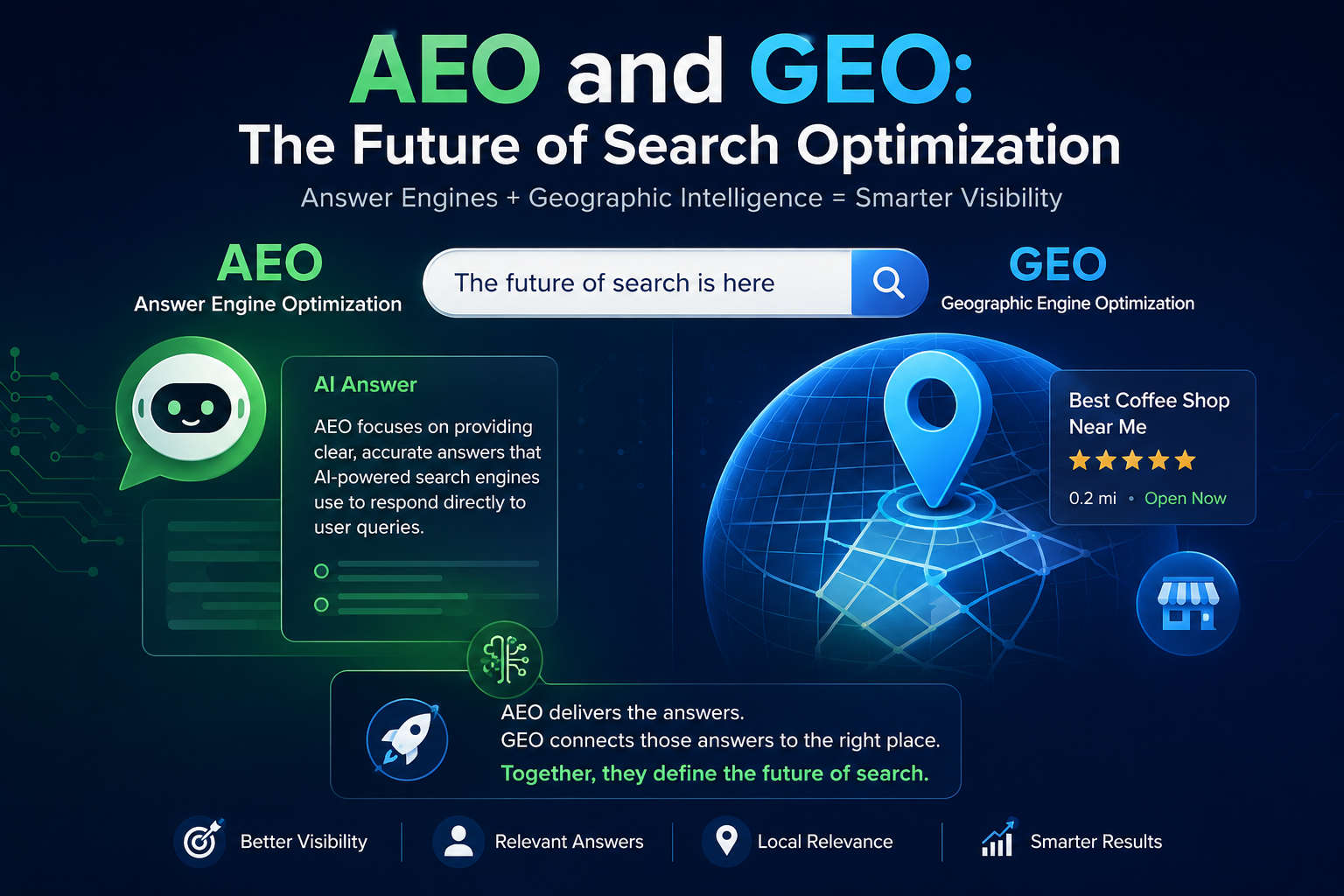
That shift makes Answer Engine Optimization (AEO) and Generative Engine Optimization (GEO) increasingly important. Instead of optimizing only to rank a webpage, you need to make your content easy for search engines and AI systems to understand, trust, retrieve, and present.
If you want your website to remain competitive, you should think beyond rankings. Your goal should be to become a reliable source that search engines, answer engines, and generative AI platforms can confidently use when responding to users.
Answer Engine Optimization focuses on helping your content appear as a direct answer to a user’s search query.
Traditional SEO often targets phrases such as “best SEO agency” or “SEO services for small businesses.” AEO takes a more conversational approach. You might optimize content for questions such as:
When you create clear answers to these questions, you give search engines structured information that can potentially be used in featured snippets, voice search results, AI-generated answers, and other search features.
Generative Engine Optimization focuses on improving your visibility within AI-generated search experiences.
AI-powered systems increasingly synthesize information from multiple sources before producing an answer. Instead of simply displaying ten webpages, these systems may summarize information and identify businesses, services, brands, or experts that appear relevant.
GEO helps you prepare for this environment.
Your content should demonstrate expertise, provide accurate information, address user intent, and establish clear connections between your brand and the topics you cover. The stronger and more understandable your online presence is, the easier it becomes for search systems to interpret your relevance.
Search optimization is no longer limited to placing keywords in titles and paragraphs. Modern search depends on context, relevance, authority, usability, and information quality.
AEO and GEO matter because users increasingly want immediate answers.
For example, someone searching for an SEO company may not simply type “SEO company.” They might ask an AI assistant, “Which SEO company can help improve my local search visibility?”
Your website needs content that addresses the underlying need, not just the keyword.
This means you should create pages that answer real questions, explain your services clearly, demonstrate expertise, and provide useful information that users can act on.
One of the most practical ways to improve AEO and GEO performance is to understand search intent.
Before creating a page, ask yourself what the user actually wants.
A person searching “SEO audit” may want to understand what an audit includes. Another person searching “SEO audit agency” may already be comparing service providers. These users have different needs.
You should create content for informational, commercial, navigational, and transactional intent.
Use headings that reflect natural questions and provide direct answers immediately after them. Then expand on the subject with examples, explanations, processes, and actionable recommendations.
This structure makes your content easier for people and search systems to understand.
Your content should answer important questions without forcing readers to search through lengthy introductions.
For example, if your heading asks, “How does AEO improve search visibility?”, answer the question in the opening sentence or two. Then explain the supporting details.
This approach improves readability and creates clearly defined information sections that answer engines can interpret more efficiently.
You should also use:
Avoid writing content simply to increase word count. Every section should serve a purpose.
Experience, expertise, authoritativeness, and trustworthiness remain important in an AI-driven search environment.
You should demonstrate why your business is qualified to discuss a particular subject. Explain your experience, processes, methodology, results, and areas of specialization when appropriate.
Your website should also make important business information easy to verify.
Maintain accurate contact details, service information, author information, business details, and supporting references. Keep your content current and correct outdated claims.
When AI systems evaluate information from multiple sources, clear and trustworthy signals can help establish your brand as a credible entity.
Keywords tell search engines what words appear on your page. Entities help them understand what those words represent.
For example, if your website discusses SEO, you should build meaningful relationships between concepts such as search engines, technical SEO, content optimization, local SEO, structured data, AEO, GEO, and digital marketing.
You can strengthen entity understanding by consistently using your brand name, services, expertise, location, and relevant industry terminology across your website and online profiles.
Avoid creating disconnected pages that repeat the same keywords without adding context. Instead, build a logical content ecosystem around your core topics.
GEO should not be treated as a replacement for traditional SEO. It should complement your existing optimization strategy.
Start by identifying the questions your customers are likely to ask AI systems.
Then create comprehensive resources that answer those questions accurately.
For example, an SEO agency could publish content about:
Each resource can address a specific user need while connecting naturally to related services and pages.
This creates topical depth and gives your website a stronger overall information structure.
Local SEO is especially important when your business serves customers in specific cities or regions.
You should clearly communicate where you operate and which services you provide. Create useful location-focused content instead of producing duplicate pages with only city names changed.
For local visibility, maintain consistent business information across your website and relevant online profiles. Your Google Business Profile should also contain accurate business details, service information, hours, and other relevant information.
Customer reviews can provide additional trust signals, while locally relevant content can help demonstrate your connection to a market.
When local intent intersects with AI search, clearly established business information becomes even more valuable.
AEO and GEO cannot compensate for a poor website experience.
Your website should be easy for search engines to crawl and users to navigate. Check your page speed, mobile usability, internal links, redirects, indexing, sitemap, canonical tags, and structured data.
You should also eliminate broken links and unnecessary technical barriers.
A strong technical foundation helps search systems access your content and understand the relationships between different pages.
Internal linking is particularly useful. Link related topics using descriptive anchor text so users and search engines can understand what they will find on the destination page.
Structured data can help search engines interpret information about your pages and entities.
Depending on your content, you may use relevant schema types for organizations, businesses, articles, products, services, FAQs, events, or other supported content.
However, you should never add structured data simply because it is available. It should accurately represent the visible information on your page and follow applicable search engine guidelines.
Accuracy matters more than quantity.
Your SEO reporting should evolve as search evolves.
Rankings remain useful, but they are not the only indicators of success.
Track organic traffic, conversions, engagement, impressions, click-through rates, branded searches, local visibility, and the performance of informational content.
You should also monitor whether your content is appearing for question-based searches and whether your brand is becoming more visible across different search experiences.
The objective is not simply to rank for more keywords. It is to increase qualified visibility and generate meaningful actions from your audience.
Implementing SEO, AEO, GEO, and local optimization together can become complex. You need a strategy that connects technical performance, content quality, search intent, entity understanding, and business objectives.
If you need professional guidance, explore a Pro SEO Agency that can help you develop a broader search optimization strategy.
The right approach should begin with your audience and business goals rather than a generic list of keywords. Your strategy should then evolve based on search behavior, content performance, technical improvements, and changing search technologies.
You can weaken your AEO and GEO strategy by focusing too heavily on keywords or producing content without a clear purpose.
Avoid keyword stuffing, repetitive articles, vague answers, unsupported claims, outdated information, excessive jargon, and thin location pages.
You should also avoid creating content specifically for AI systems while ignoring human readers.
Your first priority should always be usefulness. When your content is genuinely valuable to people, it becomes easier to build the clarity, relevance, and authority that modern search systems require.
The future of search will continue moving toward conversational, contextual, personalized, and AI-assisted experiences.
You should therefore build a website that can succeed across multiple discovery channels rather than depending on one traditional ranking format.
AEO helps you provide direct answers. GEO helps you compete in generative search environments. Traditional SEO helps your website remain technically accessible and relevant. Local SEO connects your business with geographically specific searches.
Together, these disciplines create a more complete search strategy.
Your long-term objective should be simple: be the most useful, trustworthy, relevant, and understandable source for the questions your audience is asking.
As search technology continues to develop, websites that consistently provide accurate information and strong user experiences will be better positioned to earn visibility.
AEO focuses on optimizing content to provide direct answers to user questions. GEO focuses on improving visibility and relevance within AI-generated search experiences. Both complement traditional SEO and help your content perform across evolving search environments.
Yes. Technical SEO, quality content, internal linking, crawlability, website performance, and search intent remain important foundations. AEO and GEO should extend your SEO strategy rather than replace it.
Create accurate, well-structured, comprehensive content that directly answers real questions. Use descriptive headings, demonstrate expertise, provide useful context, maintain factual accuracy, and organize related topics into a logical content structure.
Yes. GEO and local SEO can work together when you clearly communicate your services, locations, business information, expertise, and relevance to local audiences. Consistent business information and useful location-focused content can strengthen your overall local search presence.
Track organic visibility, impressions, traffic, conversions, branded searches, engagement, local visibility, and question-based search performance. You should evaluate whether your content is attracting qualified users rather than relying only on traditional keyword rankings.
AEO and GEO are becoming important parts of modern search optimization, but success still depends on strong fundamentals. Build useful content, improve technical performance, establish authority, strengthen local relevance, and make your brand easy for search systems to understand.
If you are ready to develop a more comprehensive search strategy, Contact Us to discuss your SEO, AEO, GEO, and local search goals.